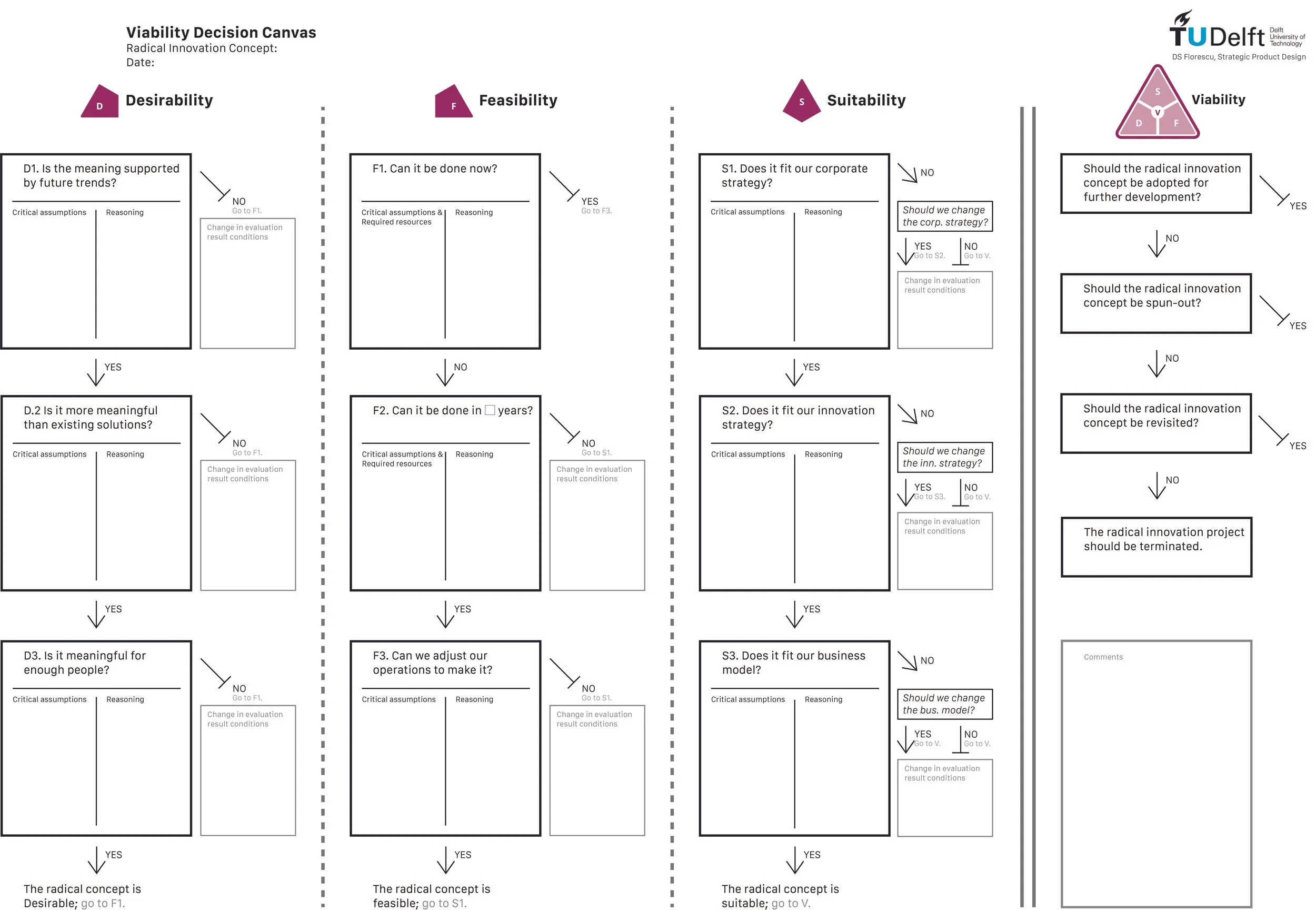
Radical innovation is a critical source for creating competitive advantage and value for potential customers. However, radical innovation has inherent characteristics that make a radical innovation project difficult to manage, such as: increased generativity – the aspect that describes how radical innovation outcomes are creative and novel, different than other radical innovation outcomes, and fundamental non-probabilistic uncertainty – uncertainty inherent to radical innovation cannot be mitigated using data-driven forecasting techniques.
Literature review and field research, consisting of qualitative interviews with experts from academia and experts working in industry, was conducted to understand the context of the decision-making process behind the internal adoption of radical innovation concepts. The research phase revealed the knowledge gap mentioned above and insights that were used towards devising design criteria for developing a tool.
The increased generativity and fundamental non-probabilistic uncertainty characteristics of radical innovation presents challenges especially when a decision regarding the internal adoption for further development of a radical innovation concept needs to be made, as financial tools, such as Return On Investment (ROI) and Net Present Value (NPV) are widely used to evaluate and make a decision regarding the internal adoption of radical innovation concepts.
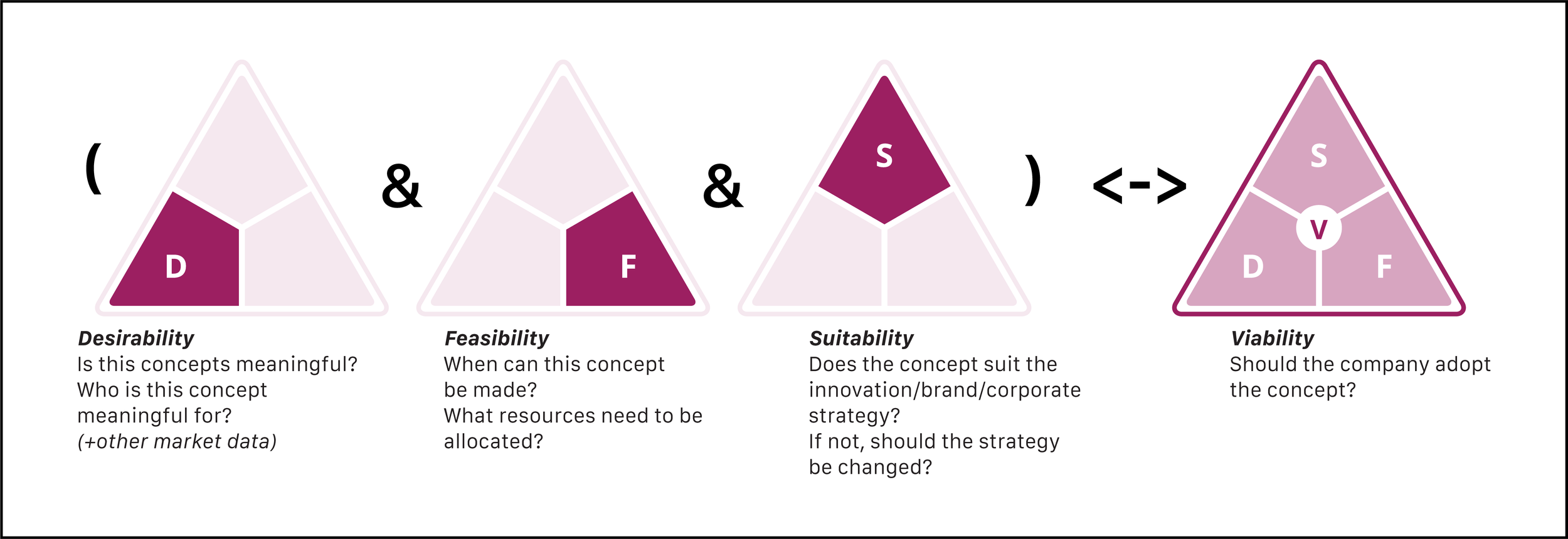
The Viability Model was designed starting from Desirability, Feasibility and Viability, as these were found to be considered critical criteria for successful innovation projects from both literature and field research. The Viability Model describes how Viability, considered to be the main decision-making criteria is modeled by desirability, feasibility and suitability, fundamental criteria for evaluating radical innovation concepts.